Search This Blog

Friday, 5 June 2026

Andrews, Arthur Alexander


Lieutenant Arthur Alexander Andrews
Andrews was born at Stuart Place, Dungannon, Co. Tyrone on 27th August 1894 to Alexander Andrews, Tea Merchant and Violet Andrews nee Morrison. They had married on 4th December 1889 at the 'Original Secession (Presbyterian) Church, Ballymoney'.

In 1901 Andrews (7) lived in house 1, Chapel Road, Dungannon with his parents and 3 siblings; Jim (10*), May (9) and Fred (6**). Three servants were also present in the house; Mathew McIbree, Hugh Mackrell and Minnie Boyd. The first 2 were also described as Tea Travellers.

In 1911 Andrews, his parents and 2 siblings, May and Fred were living in the same property. There were  2 servants also described as Tea Travellers; Isaac Troughton and George Neill were also present in the house.

Andrews probably joined the Belfast Banking Company between 1912 and the war years. His father, Alex Andrews signed the bankers Guarantee.  Arthur saw service in Portaferry, Coleraine and Bangor branches. 


Belfast Bank - Bankers Guarantee ledger sheet


Belfast Bank, Portaferry branch


Belfast Bank, Coleraine branch

Belfast Bank, Coleraine branch - interior


Belfast Bank, Bangor branch

Andrews enlisted into the Royal Irish Fusiliers in 1915 and served with their 9th and 10th Battalions first as a 2nd Lieutenant and then as a Lieutenant.

The following transcripts of newspaper articles relating to Arthur Andrews have been copied from the website Dungannon War Dead Database. My sincere thanks go to their researchers. This excellent link also provides extensive coverage of the war actions of Arthur's two brothers, 2nd Lt Wm James M Andrews (* RFC) and 2nd Lt Fred S Andrews (** Royal Inniskilling Fusiliers).

The Mid Ulster Mail dated 29th 1915 reports:
"Mr Arthur Andrews, who was home for the weekend, is the second son of Mr Alexander Andrews, Stuart Place, Dungannon. Educated at Dungannon Royal School, he obtained an appointment in the Belfast Bank after public competition. He served in the company’s offices in Portaferry and Coleraine and also in Bangor. He has answered his country’s call on Easter Tuesday and joined the Cadet Corps of the 17th Battalion Royal Irish Rifles, and is at present stationed at Newcastle, County Down." 
The Belfast News-Letter dated 13th July 1916 reports:
"Second Lieutenant Arthur Andrews, Royal Irish Fusiliers (Armagh Volunteers), who, as already reported, was wounded on the 1st July, has now written to his father, Mr Alexander Andrews, Stuart Place, Dungannon, stating that he sustained a compound fracture of the thigh, but is progressing favourably."
The Tyrone Courier dated 13th July 1916 reports:
"Second Lieutenant Arthur Andrews, Irish Fusiliers, wounded in the thigh, is the second son of Mr Alexander Andrews, Stuart Place, Dungannon, and received his commission on 23rd August 1915. Previous to this, he was in the employment of the Belfast Banking Company in Coleraine and Belfast. He was educated at the Royal School Dungannon."
The Mid Ulster Mail dated 15th July 1916 reports:
"Second Lieutenant Arthur Andrews, Royal Irish Fusiliers, has been wounded in the thigh. He is the second son of Mr Alexander Andrews, Stuart Place, Dungannon, and received his commission on 23rd August 1915. Previous to this he was in the employment of the Belfast Banking Company in Coleraine and Belfast. He was educated at the Royal School Dungannon."
The Tyrone Courier dated 20th July 1916 reports:
"Second Lieutenant Arthur Andrews, Irish Fusiliers, who as already reported, was wounded on 1st July, has written to his father Mr Alexander Andrews, Stuart Place, Dungannon, stating that he sustained a compound fracture of the thigh, but is progressing favourably."
The Mid Ulster Mail dated 22nd July 1916 reports:
"Second Lieutenant Andrews, Royal Irish Fusiliers, who, as already noted, has been wounded in action, has written to his father, Mr Alexander Andrews, Stuart Place, Dungannon, intimating that he sustained a compound fracture of the thigh, caused by a bullet wound."
The Mid Ulster Mail dated 23rd December 1916 reports:
"Second Lieutenant Arthur Andrews, Royal Irish Fusiliers, returned home to Dungannon on Tuesday suffering from wounds received in the famous advance on 1st July. He is the second son of Mr Alexander Andrews, Stuart Place, Dungannon, and received his commission on 23rd August 1915, having prior to volunteering been in the employment of the Belfast Banking Company in Coleraine and Belfast. He has sustained a compound fracture of the thigh, and the sciatic nerve had also been injured causing severe pain."
Andrews was reported in the Belfast Banking Company 'Roll of Honour' booklet as 'wounded in action'.


Belfast Bank - 'Roll of Honour' booklet

Following Andrews' demobilisation from the war, he was awarded the British Victory Medal and the British War Medal. His address as recorded on the Medal Index Card is The Royal Bank of Ireland, Letterkenny.
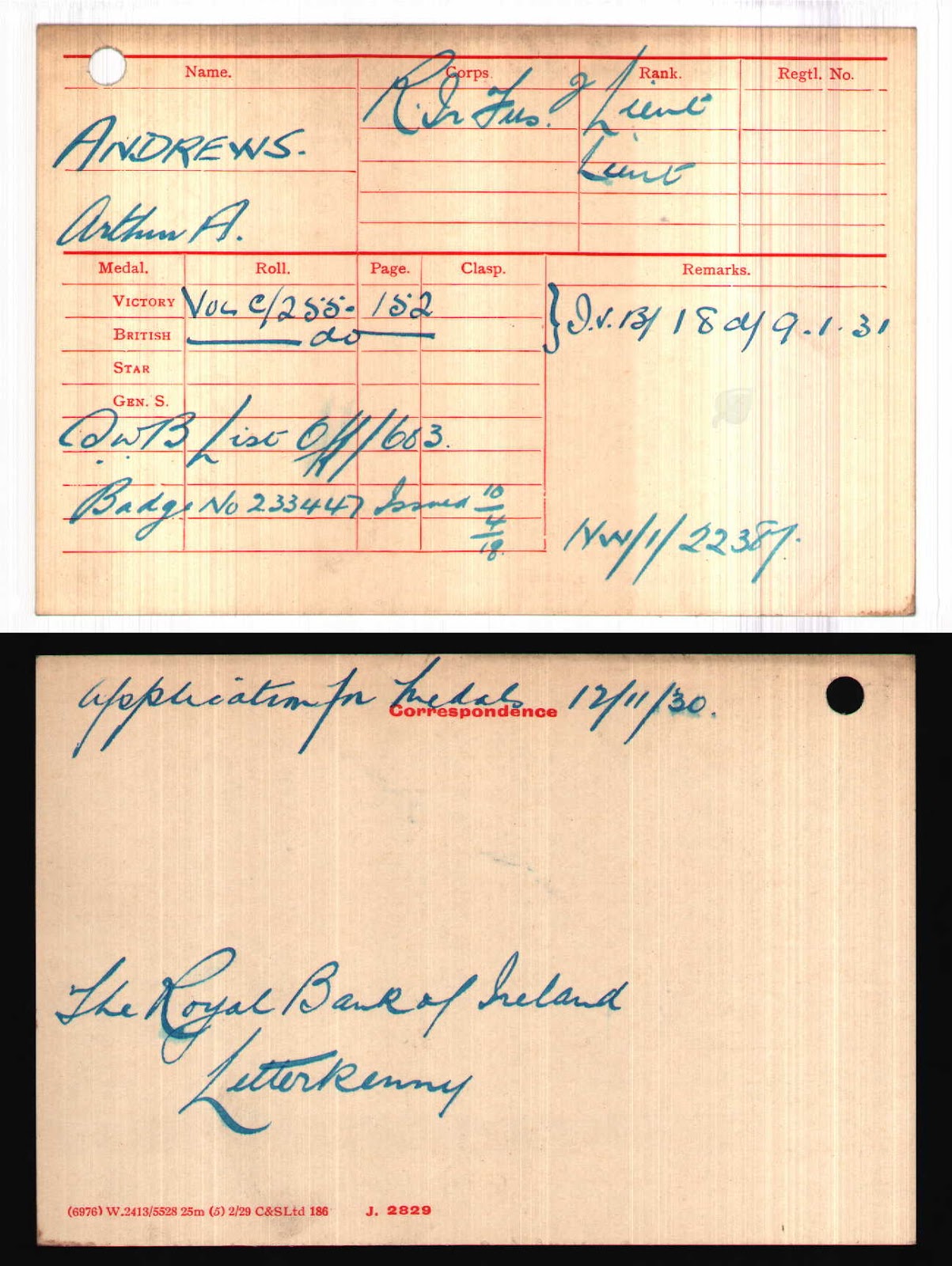
A A Andrews - Medal Index Card

A A Andrews - Medal Group
Photo courtesy of the Somme Heritage Centre (holders)

The Medal Index Card records that Andrews was also awarded a Silver War Badge numbered 233447 on 10th April 1918 as a result of his injuries.


A A Andrews - Silver War Badge roll (bottom)

A Pension Record card was created for Andrews and records his disability as a 'gun shot wound thigh'. His wife (now a widow) is recorded as Margaret Joyce Andrews.


On 25th July 1921 the Belfast News Letter reported that Mr A A Andrews of Belfast Bank was in a serious motor accident with injuries that may result in his leg being amputated.  This may be avoided as his other leg was injured during the war.


Belfast News Letter dated 25th July 1921

The Bankers Guarantee ledger sheet (above) records in pencil that Andrews 'left' the bank, date unknown.  
Jim Andrews (Arthur's brother) medals are also held by the Somme Heritage Centre:

W J M Andrews - Medal Group
Photo courtesy of the Somme Heritage Centre (holders)

William James (Jim) Morrison Andrews was born at Coolhill, Dungannon on 6th October 1890 to Alexander Andrews, Tea Merchant and Violet Andrews nee Morrison (see above). 


He volunteered and enlisted into the Royal Flying Corps and attained the rank of 2nd Lieutenant. 

Jim Andrews was killed in a flying accident over Salisbury Plain, England on 4th June 1917 and is buried in Drumcoo Cemetery, Dungannon. He is remembered on the Roll of Honour in a local church.


Further information on Jim Andrews can be accessed here.

Magee, Frederick William Henry


Captain Frederick William Henry Magee
Magee was born at Abbey Street, Armagh on 19th September 1882 to David Magee, Head Constable, Royal Irish Constabulary and Essie (Esther) Magee nee White. They had married on 9th September 1881 at Duncairn Presbyterian Church, Belfast.

In 1901 Magee's parents are living in house 29, Church Street, Strokestown, Co. Roscommon. A servant, Thomas Cummins also lives in the property. David Magee's occupation is now District Inspector, RIC.

Magee joined Northern Bank on 3rd February 1900 in Head Office. At that time, his address was recorded on the bank staff record card as Strokestown. 


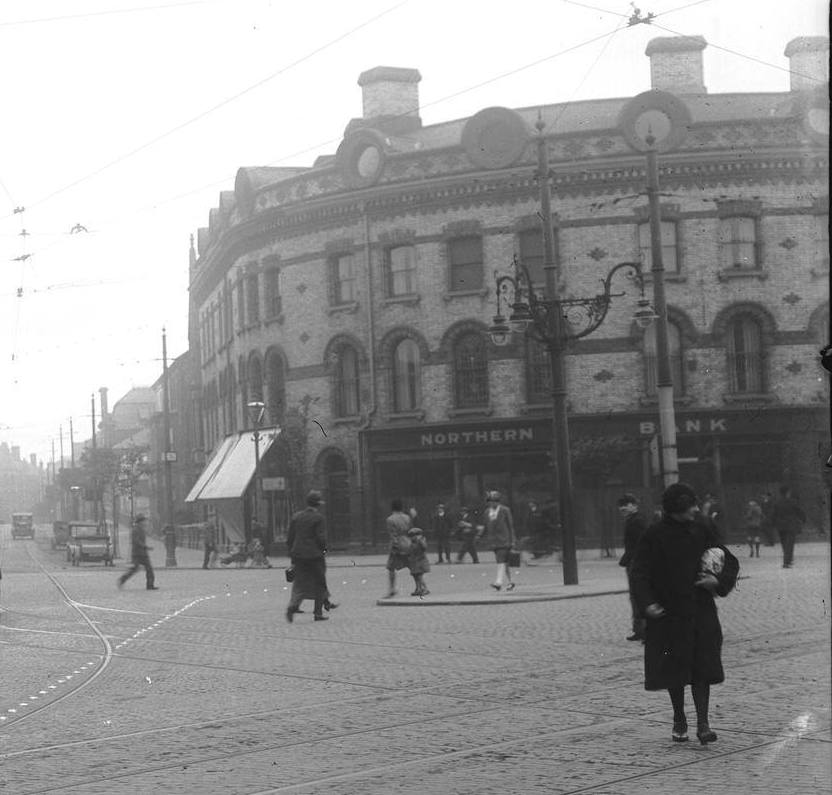
Northern Bank Head Office, Victoria Street, Belfast

Transfers followed with Londonderry (1900), Ballyclare (1900) and Mohill (1900). 


Northern Bank, Londonderry branch

Northern Bank, Ballyclare branch


Northern Bank, Mohill branch

In 1901 Magee was boarding with the Payne family in house 15, Hill Street, Mohill. 

Transfers followed to Head Office (1903), Holywood (1905), Whitehead (1907), Head Office (1911) and Ball’s Branch (1911).


Northern Bank, Holywood branch (gable wall)


Northern Bank, Whitehead branch

By 1911, Magee was living in house 9, Promenade, Templecorran, Co. Antrim with his parents and a servant, Ella McAllister. He is recorded as a Bank Official. 
Aged 33, Magee was based in Ball's branch when he volunteered for a Commission in the Royal Field Artillery. The Northern Whig of 23rd October 1915 reported his commissioning. His first theatre of war is recorded as France from 26th November 1915.

F W H Magee - Medal Index Card
(Address recorded as Northern bank, Sackville Street, Dublin)

He was promoted to Lieutenant in January 1917 and then to Captain in August 1917. Magee saw action in the Somme 1916 (Thiepval and La Boisselle), Messines 1917, Ypres 1917 (Passchendaele), Cambrai 1917, St. Quentin 1918, Amiens 1918, Bailleul 1918 and Courtrai 1918 (Allied Advance).
Demobilisation came in June 1919 and he was awarded the MID (Mentioned in Despatches), the 1914/15 Star, the British Victory Medal and the British War Medal.
The Belfast News-Letter of 8th September 1919 reported his award of the the Belgian Croix de Guerre.

2nd Lt. F W H Magee - Medal Roll 1


Capt F W H Magee - Medal Roll 2


Oak leaf MID on a British Victory Medal ribbon

Belgian Croix de Guerre

Following demobilisation, Magee re-joined the Northern Bank in Ball’s Branch, Sackville Street, Dublin later to be renamed O'Connell Street, Dublin.

Ball & Company, Henry Street, Dublin
Transfers followed with Head Office (1922) and to a new branch in Bangor (1927).


Northern Bank, Bangor branch (site now redeveloped)

The Belfast News-Letter of 1st September 1928 reported the engagement of F W H Magee, Northern Bank House, Bangor to Betty Douglas-Browne of Riverside, Holywood. Their wedding was reported in the Belfast News-Letter of 1st May 1929:


Further transfers followed to  Armagh (1933) and Dungannon (1941).


Northern Bank, Armagh branch

The British Newspaper Archive holds many press reports about Magee and his yachting interest.
Magee retired on 24th July 1945. He subsequently moved from Armagh to Dublin selling all his house contents as per this advertisement in the Portadown News of 16th October 1948:

Frederick Magee died aged 75 on 28th November 1957 and left his estate to his widow, Fannie Betty Magee.

Weir, William


Lieutenant William Weir
Weir was born in Ballykeel, (Ballynahinch Road), Lisburn on 11th January 1887 to Thomas Weir, Farmer and Margaret Jane Weir nee Adair. 

Thomas Weir (father) died aged 59 on 29th November 1888 at Hillsborough.

In 1901, Weir (Willie 13) lived in house 31, Dromore Street, Ballynahinch, Co. Down with his mother and 5 siblings; Agnes (25), Maggie (24), Rebecca (20), Thomas (18) and Sarah (16).
 
On 12th December 1904 he joined Northern Bank at Head Office. Transfers followed to Grafton Street (1905), Hillsborough (1906), Dungloe (1909), Head Office (1910) and Lisburn (1910). 


Northern Bank, Head Office, Victoria Street, Belfast


Northern Bank , Grafton Street, Dublin
 (tall building with chimneys)


Northern Bank, Dungloe branch


Northern Banking Company Lisburn branch
(building replaced in 1920s)

In 1911, Weir was living in house 23, Burmah Street, Ormeau Ward, Belfast with his mother, sisters Rebecca and Sarah and a step brother, Oliver Watson (2) and a step sister Mabel Watson (1). Mary Jane Weir had married Oliver Watson on 11th September 1907 at Ballynahinch.

Weir played golf in the first Northern Bank golf outing on 21st March 1913 at Dunmurry:


Photo courtesy of LennonWylie

On 12th February 1915, whilst based in Lisburn he volunteered and enlisted into the Honourable Artillery Coy (Infantry) as a Private with Service Number 7016. He rose through the ranks until he went to Cadet School. 


W Weir - Medal Index Card

Weir was later gazetted as a 2nd Lieutenant in the Kings Own Royal Lancaster Regiment before being posted to the 2nd Kings Own Royal Lancaster Regiment. Subsequently he was promoted to Lieutenant. He saw service at Macedonia, Army of Occupation Chanak, Dardanelles and Bullecourt.

Weir received a slight gunshot wound to the left shoulder. Demobilisation came in November 1919. He was awarded the British Victory Medal and the British War Medal.


W Weir - Medal Roll

Following demobilisation he re-joined Northern Bank on 1st December 1919 in Lisburn. 

In December 1919 he married a Miss Johnston of Lisburn. 

The Lisburn Standard of 21st October 1921 carried this advertisement with William Weir mentioned:


Transfers followed to Saintfield (1923), Antrim (1924), Limavady (1929), Donegall Square (1936), Royal Avenue (1941) and Donegall Square – Manager (1943).


Northern Bank, Saintfield branch (later building)


Northern Bank, Antrim branch


Cheques drawn on Northern Bank, Limavady branch


Northern Bank, Donegall Square branch (centre building)


Northern Bank, Royal Avenue branch

The British Newspaper Archives carry many clippings mentioning William Weir linked to Antrim and Limavady branches. He was also involved in the Royal British Legion and various rugby clubs.

The Staff Magazine ‘The Link (August 1981)’ contains a photograph of Weir in a 1913 Northern Bank Staff Golf outing.


Wm Weir - 1913 Northern Bank Golf Outing

William Weir is remembered on a memorial in Railway Street Presbyterian Church, Lisburn.

PRONI wills records "Weir William of 486 Lisburn Road Belfast retired bank manager died 16 December 1958 Probate Belfast 9 March to Northern Bank Limited. Effects £2000 3s. 6d.".

Keeling, George Dennison


George Dennison Keeling
Keeling was born at 107 South Parade, Belfast on 19th April 1897 to John William Keeling, Marine Engineer of 12 Florenceville Avenue, Belfast and Elizabeth Frances Theodora Keeling nee Lamont. They had married on 14th May 1896 at Newtownbreda Church of Ireland.

In 1901 Keeling (4) is living in house 71, South Parade, Ormeau, Belfast with his parents and a sister Dorothy (2).

William Keeling died 'at sea' on 20th June 1906 (Ancestry family tree).

By 1911, Keeling was residing in a boarding school at number 19.1, St. Laurence Street, St. Laurence Gate, Drogheda, Co. Louth. There were 4 teachers and 20 pupils in the school on Census Day 1911.

On 23rd October 1913, Keeling joined Northern Bank at Head Office. Transfers to Shaftesbury Square (1914) and Head Office (1915) followed.


Northern Bank, Head Office, Victoria Street, Belfast


Northern Bank, Shaftesbury Square branch

On 1st January 1915 Keeling volunteered and enlisted into the 6th Bn. Black Watch (Royal Highland Regiment) with Service Number 2686. He later transferred to the Seaforth Highlanders.


G D Keeling - Medal Index Card

The Belfast News Letter of 8th October 1915 reported his address is recorded as 48 Elmwood Avenue, Belfast.


The London Gazette records a 2nd Lieutenant G D Keeling relinquishing his temporary commission as of 7th May 1916.
 The bank Staff Ledger records Keeling as re-joining the bank on 3rd July 1916 and was based again in Head Office.
 On 6th January 1917, Keeling volunteered again.

The picture on the Roll of Honour indicates that Keeling may have been awarded the Military Medal.

Military Medal

Keeling re-joined the Northern Bank on 3rd February 1919 at Head Office and was then transferred to Downpatrick (1919) and then back to Head Office (1919).

Northern Banking Company Limited, Downpatrick
Keeling is remembered on the Roll of Honour in St Jude's Parish Church, Belfast.


[Photo courtesy of John McCormick]

Keeling resigned from the bank on 28th February 1920 and 'left for Canada' to 'settle there' with other members of his family. His 'Passenger Declaration' card records George's occupation as a 'Bank Clerk' with an intention to start 'Farming or Lumber'.

G D Keeling - Passenger Declaration - 1920

G D Keeling - US & Canada Arrivals Card - 1920

The 1921 Canadian census records Keeling as living at house 400, 35 42 Cambridge Street, Vancouver, Canada with his mother, Elizabeth and siblings; Dorothy and Beatrice. His occupation is recorded as a Bank Cashier earning Cad$1,200.
On 14th march 1934 Keeling married Gladys Ruth Davey (Ancestry family tree). A son, Barry Dennison Keeling was born on 16th March 1944 (Ancestry family tree).
George Keeling died in Vancouver, Canada on 27th May 1966 aged 69.