Search This Blog

Thursday, 6 February 2025

Roberts, Hugh Stanley


Lance Corporal Hugh Stanley Roberts
Roberts was born at Rigg, Ely, Co. Fermanagh on 18th September 1895 to Samuel Thomas Roberts and Margaret Jane Roberts nee Nixon. They were married on 20th August 1884 in Enniskillen.

In 1901 Roberts was living in house 1, Rigg, Ely, Co. Fermanagh with his parents and 2 sisters; Katie (14) and Lillie (13). Two servants were also in the house, Patrick Murphy and Mary Maguire.

In 1911 Roberts was living in house 7, Rigg, Ely, Co. Fermanagh with his parents, 2 sisters and a brother, Thomas N (18).
On 11th April 1913, Roberts joined Northern Bank at Head Office.   

Northern Bank, Head Office, Victoria Street, Belfast

Transfers followed to Fintona (1913 - Junior) and Head Office (1914). 


Northern Bank, Fintona (Photo courtesy of Allan McCullough Family)

On ‘Ulster Day’, Saturday, 28th September 1912, Roberts signed the Ulster Covenant at Enniskillen. 
In September 1914, Roberts volunteered and enlisted into the 9th Bn. Royal Inniskilling Fusiliers as a Private with Service Number 13613. This was to be for the ‘duration of war’. His first theatre of war is recorded as France from 15th November 1915.

H S Roberts - Medal Index Card

Prior to being killed in action, aged 20, on 1st July 1916 he was promoted to Lance Corporal (Corporal 2nd). His name is recorded on a grave in the Rossorry Church of Ireland graveyard.

Roberts was awarded the 1915 Star, the British Victory Medal and the British War Medal. He is commemorated on the Thiepval Memorial and in the UK Commonwealth War Graves.

UK Commonwealth War Graves 1914-1920 - H S Roberts

The Register of Soldiers' Effects records that Roberts' father, Samuel T Roberts received £9 1s 3d on 17th January 1917 and that his mother received £8 0s 0d on 22nd October 1919 as a War gratuity.


Register of Soldiers' Effects - H S Roberts

A Pension Record Card was created in respect of Roberts' mother.


Pension Record Card - H S Roberts

Mathews, William Frederick Alexander


Private William Frederick Alexander Mathews
Mathews was born at 15 Windsor Road, Dublin on 16th November 1893 to Marcus Beresford Mathews, Bank Clerk and Annie Mathews nee Henry. They had married on 23rd February 1886 at Clones Presbyterian Church.

In 1901 Mathews is living in house 31.1 Henry Street, North City, Dublin with his parents and 6 siblings; Ada (13), Annie (9), Helen (1), Richard (14), Alfred (3) and Marcus (11). Two servants, Mary Smyth and Sarah Nicholson are also living in the house. Marcus Beresford Mathews is described as a Bank Manager.

On 6th August 1910, Mathews joined Northern Bank at Ball’s branch, Dublin.


Ball & Company, Henry Street, Dublin

By 1911, Mathews is living in house 115 Grafton Street, South City, Dublin. (Northern Bank House) with his parents and 6 siblings; Adelaide, Annie, Alfred, Helen, Reginald and Mary. Marcus is recorded as a bank manager and William is recorded as a bank official.  


Northern Bank, Grafton Street, Dublin branch

A transfer to Head Office followed in 1914.


Northern Bank, Head Office, Victoria Street, Belfast

On 15th April 1914, Mathews volunteered and enlisted into the 7th Bn. Royal Dublin Fusiliers as a Private (M.G.S.) with Service Number 14199.


Mathews, W F A - Medal Index Card

Mathews fought in battles at Suvla Bay Landing and Chocolate Hill before he was Killed in Action on 13th September 1915 aged 21.

Mathews was awarded the 1914/15 Star, the British Victory Medal and the British War Medal.

He is commemorated on the Helles Memorial, Turkey and in the family church, St Werburgh, Dublin.
 
Many thanks to the Facebook group Royal Dublin Fusiliers for posting this family memorial from the church.


The Register of Soldiers Effects records that Mathews' pay and war gratuity was paid to his father, Marcus.


Mathews, W F A - Soldier's Effects Ledger

Mathews was commemorated in a Gallipoli Centenary event [video] at the Northern Banking Company exhibit, Ulster Folk Museum, Cultra in April 2015.


Kennedy, William


Private William Kennedy
Kennedy was born on 13th November 1892 in Wishaw, Lanarkshire, Scotland, the son of the Reverend Samuel Guiler Kennedy and Christina Lary (maiden name unknown).

In 1901 Kennedy (8) lived in house 5, Crescent Gardens, Windsor, Belfast with his parents and 3 siblings; Christina Lary (6), J A Chancellor (5) and James (2). A servant, Helena Jane McCready also lived in the house.

Following his education at RBAI (Inst), Kennedy joined Northern Bank on 4th January 1910 at Head Office.


Northern Bank, Head Office, Victoria Street, Belfast

Transfers followed to Shaftesbury Square (1910 - Junior), Magherafelt (1911 - Junior), Shaftesbury Square (1912 - Junior) and Head Office (1912 - Relief Staff).  


Northern Bank, Shaftesbury Square branch


Northern Bank, Magherafelt branch

Kennedy's bank staff ledger records "Willing to deliver passbooks to private houses".

In 1911 Kennedy was living in house 31, Cromwell Road, Cromac Ward, Belfast with his parents and 5 siblings; Christina (18), Josias (15), James (12), Samuel (9) and Herbert (8). A servant, Annie Trainor was also living in the property. William's occupation is recorded as a Bank Clerk. 


On 9th September 1914, whilst based in Head Office, he volunteered and enlisted into the 14th Bn. Royal Irish Rifles as a Private (Rifleman) with Service Number 14/16657. His unit is also recorded as the Young Citizen Volunteers. His first theatre of war is recorded as France from 5th October 1915.


William Kennedy - Medal Index Card

Kennedy was killed in action on 7th June 1917 and is buried in the Spanbroekmolen British Cemetery, Belgium. 

In the July 1917 edition of the Inst School News, it was announced that Kennedy had been awarded a Certificate for Gallantry in the field.

He was awarded the 1914/15 Star, the British Victory Medal and the British War Medal.


Kennedy is also remembered on the RBAI (INST) 1914-18 War Memorial:

Photograph courtesy of LennonWylie
Administration of the Estate of Kennedy was granted at Belfast to Reverend Samuel G Kennedy.  Kennedy's effects were £200.

*  Thanks must go to this website for some of the photographs - Kennedy Genealogy.

Also see S G Kennedy who was a cousin and worked for the Belfast Banking Company.

Tuesday, 14 January 2025

Stewart, Eric Hilton


Corporal Eric Hilton Stewart
Stewart was born in Belfast on 15th July 1895 to Harry Hilton Stewart, Bank Clerk and Anna Mary Maude Stewart nee Young. They had married on 11th May 1893 at St. Barnabas Church, Belfast.

In 1901 Stewart (5) was living in house 15, (Chattenden), Chichester Park, Belfast with his parents, 2 aunts Margaret Elizabeth and Emily Alice and 2 siblings, Percy Malcolm (1) and Marjorie Evelyn (0).  Harry's (father) job was recorded as a Bank Clerk.

In 1911 the parents are living in house 20, Salisbury Avenue, Clifton Ward, Belfast with their family aged Marjorie (10), Ethel (4) and Alan (1). There are 2 servants as well. Harry's (father) job was recorded as Bank Inspector. Eric would have been aged 15 or 16 in 1911. He was not present in the family home on Census Day and was recorded as residing in house 1.2, College Hill, Armagh. This is probably Armagh Royal School. 

On ‘Ulster Day’, Saturday, 28th September 1912, Stewart signed the Ulster Covenant at Cliftonpark Church Lecture Hall and gave his address as 5 Salisbury Villas, Chichester Park, Belfast.

Stewart joined Northern Bank on 5th October 1913 in Head Office. Transfers to Shaftesbury Square (1913) and Head Office (1914) followed.


Northern Bank, Head Office, Victoria Street, Belfast


Northern Bank, Shaftesbury Square branch

In September 1914, Stewart volunteered and enlisted into the Royal Fusiliers (Public Schools and Universities Bn.) as a Private with Service Number FS5676. His first theatre of war is recorded as France from 15th November 1915. He was promoted to Lance Corporal and then to Corporal. 


Eric H Stewart - Medal Index Card

Stewart was serving with the 20th Bn. Royal Fusiliers when he was killed in action on 16th July 1916 aged 21.

He was awarded the 1914/15 Star, the British Victory Medal and the British War Medal and is commemorated on the Thiepval Memorial, France.

The Belfast News Letter of 25th July 1916 reports:


Following his death, Stewart's final pay and benefits was awarded to his father, Harry H Stewart, Chief Inspector, Northern Banking Company. Harry died in 1940.


Eric Stewart - Register of Soldiers' Effects

Furniss, James


2nd Lieutenant James Furniss

Furniss was born in Cheshire, England on 13th November 1888 to John E Furniss, Mine Manager and Ellen Furniss. 

In 1901, Furniss was living in house 6, Staid, Ballynure, Co. Antrim with his parents and 3 siblings; John (10), George (8) and Herbert (4). Schooling for James was at Skerry's College, 143 Royal Avenue, Belfast. The school is described as one that prepares candidates for the Civil Service. 

On 10th April 1905, he joined Northern Bank, firstly going to Head Office, Victoria Street, Belfast.


Northern Bank, Head Office, Victoria Street, Belfast

Over the next 10 years, Furniss saw service in Grafton Street, Dublin, Head Office and back again to Grafton Street.


Northern Bank, Grafton Street, Dublin branch

In 1911, Furniss is boarding with the Lauder family in house 26, Parnell Place, Rathmines and Rathgar West, Dublin. A Northern Bank colleague, John Andrew McNutt (b.1887) is also boarding in this house. Both have their occupations described as Bank Officials.  

Whilst working in Dublin, Furniss joined the Clontarf Cricket and Football Club, Castle Avenue, Clontarf, Co. Dublin. There is one newspaper report of James taking part in a cricket match in 1913.  This appears to have been the only match he played in that year. There were to be no further matches in the period 1914 to 1919. During the war the club was closed, as most members had gone to war and the land was cultivated as part of the national food security, the war-time food economy.

On ‘Ulster Day’, Saturday, 28th September 1912, George, Herbert and John Furniss signed the Ulster Covenant at Straid and Ballyboley (Herbert). Ellen signed the Women’s Ulster Declaration at Ballyclare.

Whilst the war had started in 1914, Furniss decided to wait until 1916 before volunteering for military service. Although he was working in Grafton Street, Dublin, James travelled to London to enlist into the Inns of Court Officer Training Corps (OTC).  

Furniss enlisted for war service on 9th February 1916 into the Inns of Court OTC at Stone's Building, London. This address was probably a recruiting office. His contract would have been counter-signed by an Ensign (who would probably have been a 2nd Lieutenant), a Justice of the Peace or an Officer or other authorised person permitted to certify recruits, as well as a witness.

There was a medical examination on the same day. It says that James Furniss’ age was 27 years and one month. He was 5 feet 9 inches tall and weighed 146 lbs. His vision was 6 / 6 and his general physical condition was described as ‘good’. The medical examination was summarised as ‘fit for service in the Inns of Court OTC’.

Furniss was accepted for service at the Inns of Court Officer OTC as a private with Service Number 9404. The document states that he is unmarried, a British citizen and has shown good morals. The latter was certified on 29th July 1916 by two people. They were the vicar of Holy Orders in Ballynure who testified that James Furniss had a good morale in the last 25 years and a person named Logan who resided in Co. Antrim who testified that James Furniss had shown good morality throughout life. It further says that James Furniss has sufficient civilian training to become an officer, as attested by the Principal, John W. Renshaw, Shaftesbury House, Botanic Avenue, Belfast. This was a Tutorial College in Belfast.

9404, Private James Furniss, Inns of Court OTC was ordered to appear for service on 3rd November 1916 at No. 7 Officer Cadet Battalion in Moore Park, Fermoy. He trained there until 28th February 1917 when he was promoted to 2nd Lieutenant and posted to the Royal Irish Rifles. His training grade was rated ‘Good’.


James Furniss - Medal Index Card

A document from the Ministry of War (War Office) dated 2nd April 1917 appointed James Furniss to 2nd Lieutenant in the Special Reserve of Officers (4th Bn. Royal Irish Rifles). It is signed by Colonel M D Graham, Assistant Military Secretary, with a copy to be sent to the responsible officer at the 4th Bn. Royal Irish Rifles, Sunny Lands, Carrickfergus. As is usual with officer’s promotions, the appointment was also announced in the London Gazette.

Furniss served in this regiment until the spring of 1917 when he was posted to the 1st Bn. Royal Irish Rifles, which then belonged to the 8th Division. 
The 25th Brigade, which the 1st Royal Irish Rifles was attached to on this occasion, had the task of passing through the 23rd and 24th Brigades at the height of the Westhoek Ridge, which ran between Frezenberg and Westhoek Road. The goal was to reach the "Green" line which was an imaginary line in the terrain that ran from Zonnebeke in the west to the left edge of Polygon Wood. This second phase of the attack was carried out by three battalions, the 2nd Lincolnshire to the right, the 1st Royal Irish Rifles in the middle and the 2nd Rifle Brigade on the left.
At 06.00 hours in the morning, the battalion moved from the Halfway House and half an hour later there came reports that said that the 23rd and 24th Brigades attack had been a complete success. Furniss’ battalion was then ordered to advance towards Westhoek Ridge in so called artillery formation. This was a formation that meant that the battalion was advancing according to a specific pattern in which squads were scattered in order to be less vulnerable to artillery fire.
When they approached the Westhoek Ridge at 08:30 hours, it quickly became apparent that the situation was not what they expected. The advancing brigades had in itself made a successful advance, but they had not managed to occupy positions in "The Black Line" on Westhoek Ridge adjacent to the Polygon Wood, as the officers had previously thought.
Whilst the British artillery opened the new barrage against the German positions, Furniss’ battalion went into the attack in perfect formation. It was then just after 10:00 hours (Zero hour + 6 hours 20 minutes with zero hour being 03:50 hours).
The Battalion's left company, D Company, had met with declining fire from machine guns and snipers, both directly in front of them and from their right flank, when they began their advance from the Black Line.  D Company was forced soon after to the ground by the enemy machine-gun fire that came from German positions just west of the area that had recently been exposed to the barrages. The D Company Commander then gave orders that they would attack in sections, but losses the first minute were so terrible that they immediately had to stop the attack and retreated to their original positions and hold them. This company got in touch with the 2nd Rifle Brigade which at that time was on their left. ‘A’ Company to the right had been stopped by the same reason. The Battalion middle Company, B, managed to move up all the way to Hannebeke Brook, a truly magnificent feat under the circumstances. But it turned out after a while that it was impossible for them to defend these new positions as the enemy worked their way around their right flank, so even this company was forced to retreat. The Company Commander gave orders to retreat until each flank was secured and had established contact with each company off both their right and left side. Colonel Reid, who had command of the battalion only a short time had won the affection and confidence of officers and ranks at all levels, was killed shortly after the attack began. 2nd Lieutenant James Furniss also died at this time and at the same place as Reid.
They managed to beat back a few minor counterattacks on the German side, but at 15:00 hours the situation became more serious when the Germans brought up reinforcements. It was later reported from their observers that the Germans brought in new fresh troops by truck from Zonnebeke. The entire weight of the counter case fell on the Lincolnshire and Royal Irish Rifles middle Company, B, and in some places reached the enemy in their trenches. The surviving soldiers who had been pushed back rounded up by the few remaining officers and soldiers and went to counterattack. They managed to push back the Germans in a powerful counter-attack, which left behind lots of dead. A machine-gun was also captured. The German counter-offensive was definitely broken and the ground gained by the 23rd and 24th Brigades during their past successes, could be held.
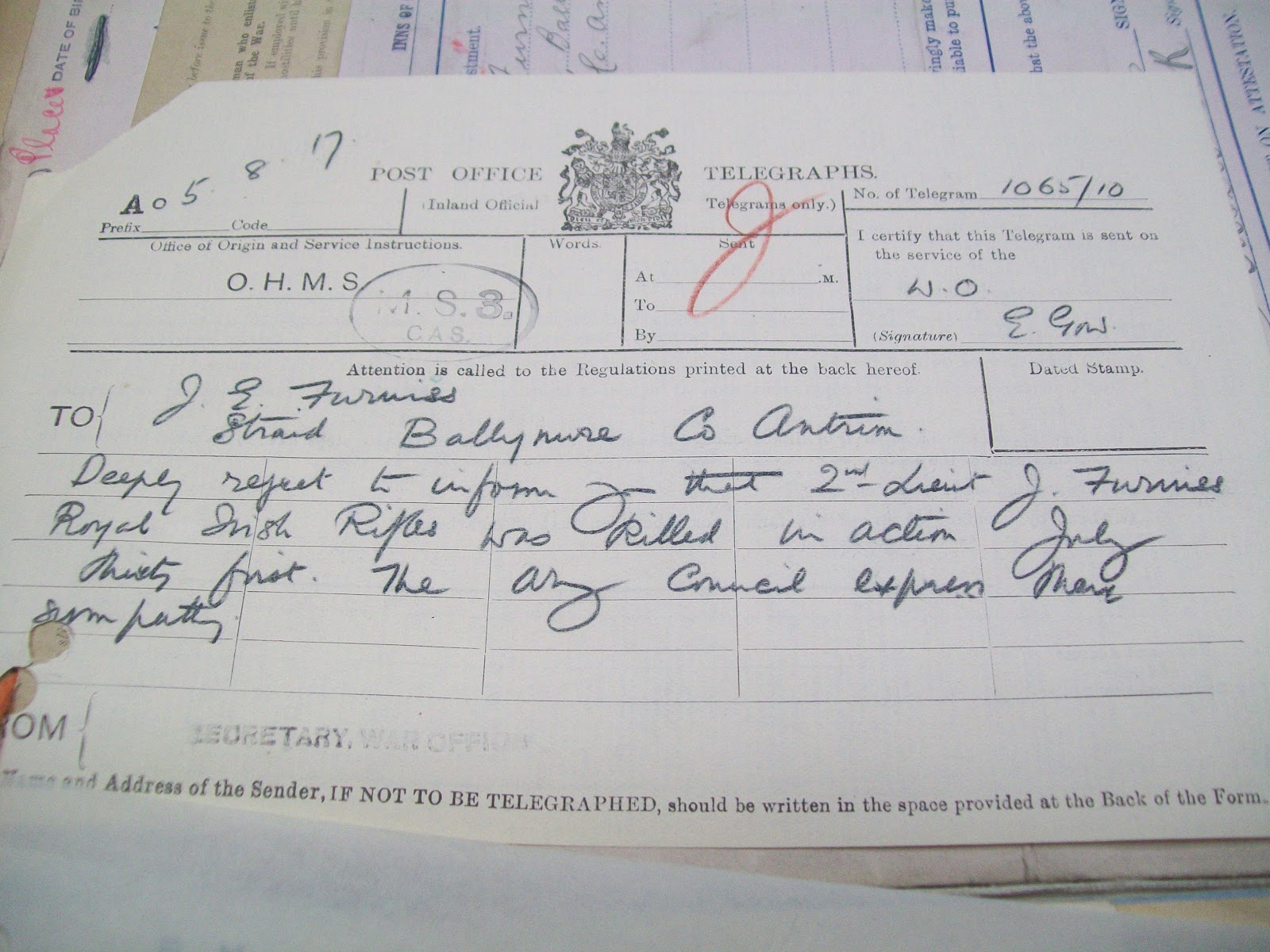
2nd Lieutenant James Furniss died on Tuesday, 31st July 1917, on the first day of the Third battle of Ypres. The weather report that day was overcast and the temperature was nearly 70 degrees Fahrenheit with nearly 1 inch of rain falling late in the afternoon.  Earlier in the day had been overcast with fog in the morning, but dry. [This data was derived from notes in the Meteorological Office archives].
The Belfast News Letter of 9th August 1917 reports:


The Belfast News Letter of 10th August 1917 reports:


When James Furniss died, the army advised the family that he had saved a total of £6 18s 1d. The money was sent to his brother, the Rev. George Furniss through a law firm based at 9 Chichester Street, Belfast.

His body was never found.

His brother, George Furniss married Miss Elizabeth Mary Chapman in 1923. She was the daughter of William Chapman from the Magheralave area in Lisburn. George ministered at Christ Church, Derriaghy; St. Paul’s, Belfast; Drumgooland and St. Patrick's, Newry before retiring in 1936. He died the following year, 1937.

Another brother, Herbert also worked for the Belfast Banking Company.  

2nd Lieutenant James Furniss is commemorated on the Ypres (Menin Gate) Memorial, West-Vlaanderen, Belgium.  He was also awarded the British Victory Medal and the British War Medal. He is also commemorated on the Roll of Honour of the Clontarf Cricket and Football Clubs. During the Great War, 129 members of the club served with 24 paying the supreme sacrifice.

The other brother, Captain John Edward Furniss MC served with the 12th Bn. and the 4th Bn. Royal Irish Rifles. He was a recipient of the Military Cross and survived the war although badly wounded.


The Belfast News Letter of 24th April 1916 reports this of his brother, J E Furniss:


The Belfast News Letter of 13th June 1916 reports this of his brother, J E Furniss:

The Belfast News Letter of 28th July 1916 reports this of his brother, J E Furniss:


Probate of the Will was granted at Belfast to The Reverend George Furniss, Clerk. Furniss' effects were £356 17s.

Curran, Herbert


Private Herbert Curran

Curran was born at 5 Rossmore Avenue, Ormeau, Belfast, Co. Antrim on 20th August 1894 to Miles Curran and Edith Curran nee Bruce. They had married on 22nd May 1888 at Duncairn Presbyterian Church, Belfast. Miles' occupation is recorded as a Book-keeper.
In 1901 Curran (6) was living in house 64, North Parade, Belfast with his parents and 5 siblings; Harold T (11), Edith (10), William (8 - Royal Fusiliers, Service Number 8034), May (3) and 
Lancelot Ernest (2 - RFC / RAF, Service Number 75518). A servant, Rose Maguire was also present in the house.

By 1911, Curran was living in house 29, College Gardens, Belfast with his parents and 5 siblings, Harold, William, May, Lancelot and Gerald (5). A maid, May Considine was also staying in the house.

On 1st May 1912, Curran joined Northern Bank at Head Office. Transfers followed to Shaftesbury Square (1912 - Junior) and Head Office (1913). 


Northern Bank, Head Office, Victoria Street, Belfast


Northern Bank, Shaftesbury Square branch
On 2nd December 1914, Curran volunteered and enlisted into the 24th (2nd Sportsman’s) Bn. Royal Fusiliers (City of London) as a Private with Service Number 2101. His first theatre of war is recorded as France from 15th November 1915.


Herbert Curran - Medal Index Card

Curran was aged 21 when he was killed in action on 7th May 1916. His battalion were in trenches in the vicinity of Fosse 10, Sains-en-Gohelle when a shell hit a bombproof shelter, killing four men, including Herbert.


Curran is buried in the Tranchee de Mecknes Cemetery, Aix-Noulette., Pas de Calais, France. 
Curran is remembered on the Elmwood Presbyterian Church, Belfast War Memorial. This was rediscovered recently by History Hub Ulster in the Elmwood Presbyterian Church, Lisburn after 30 years in a cupboard.


Curran is also remembered on the RBAI (INST) 1914-18 War Memorial:

Photograph courtesy of LennonWylie

Curran was awarded the British Victory Medal and the British War Medal. 


Herbert Curran - Medal Roll

Following Curran's death, his final pay and awards was claimed by Miles Curran.


Herbert Curran - Register of Soldiers Effects
Administration of his Will was granted at Belfast to Miles Curran, Secretary. Herbert's effects were £196 5s 4d.


On ‘Ulster Day’, Saturday, 28th September 1912, William Curran (an older brother) signed the Ulster Covenant at the Old Town Hall, Belfast.

Major Sir Lancelot Ernest Curran

Lancelot was the youngest son of Miles Curran and Edith Curran. Born in 1899, Lancelot was to enlist in the Royal Flying Corps (RFC) around 1916 / 1917.  

Following demobilisation, Major Lancelot Curran was to take up the legal profession and politics. He was at various times, a High Court Judge, an MP (at Stormont). the Attorney General for NI and a Privy Councillor. from 1957 until his death in 1984.

Lancelot married Doris and they had 3 children including a daughter called Patricia. Sadly Patricia was to have been murdered in 1952 in what has become one of Northern Ireland's notorious and as yet unsolved crimes. There have been many news reports on the case. This is one from the Belfast Telegraph for reference.